
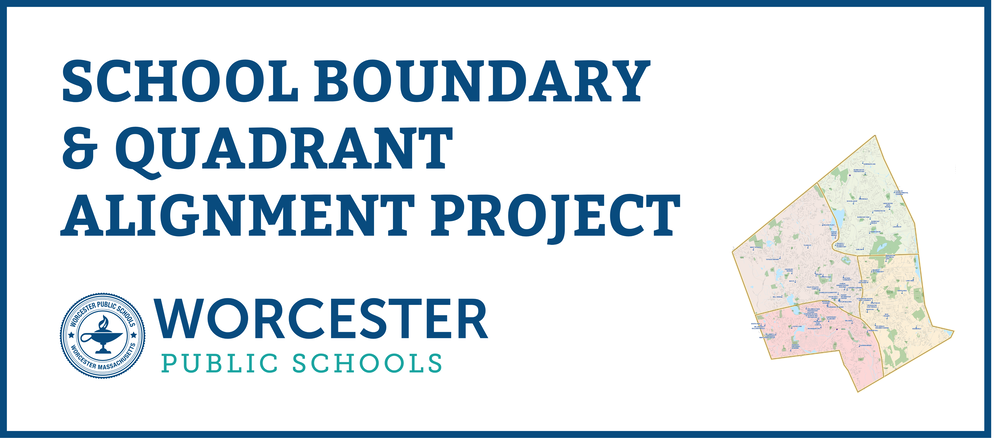
Dillinger Research and Applied Data has released its recommendations, along with elementary school boundary Scenarios 4 and 5, for the Worcester Public Schools (WPS) Boundary and Quadrant Alignment Project. The recommendations are the culmination of 11 months of data analysis and adjustments based on public feedback.
An official presentation of the recommendations is scheduled for Monday, November 16, at 6:00 PM, at a public meeting of the Worcester School Committee’s Standing Committee on Operations and Governance, which will be held at South High Community School, 170 Apricot Street.
The School Committee will deliberate these recommendations and vote on a final scenario in December. (Public meeting timeline.) No decisions have been made at this time.
Here is a summary of the scenarios now under consideration.
Recommendation #1: Development of Implementation Timeline
It is recommended that WPS begin a partial implementation of recommendations for the 2027-28 school year, and also use January-March 2027 to develop a full implementation plan that would result in complete implementation in 2030-31.
Recommendation #2: Expand Full Day Preschool (Pre-K)
It is recommended that WPS convert half-day preschool programs into full-day programs over the next three years, while repositioning classrooms to best match the population of preschool-age children for its geographic quadrant. This plan would be phased in based on facility readiness and funding. The recommendation also calls for creating full-day preschool seats in all elementary schools where there is adequate space as funding and facility readiness allows.
Recommendation #3: Centralized Program Access
It is recommended that WPS manage all district-wide program applications through one central, transparent process, with seat allocation designated to give students in every quadrant equitable access in a manner that is consistent with state Department of Elementary and Secondary Education (DESE) requirements. Specifically, this recommendation refers to Chapter 74 career technical education programs; Goddard Scholars Academy; Hanover Insurance Academy for the Arts; and the Burncoat Arts Magnet Program.
Recommendation #4: Centralized Voluntary Transfer Process
It is recommended that WPS limit voluntary transfers and approve them centrally based on available capacity at both the sending and receiving school. (Voluntary Transfers are when a family requests their child attend a school that is not assigned to their residential address.) Currently, decisions are made on a school-by-school basis.
Recommendation #5: Adjust School Day Start and End Times to Expand Transportation Access
Currently, schools across WPS start their days at 12 different times. It is recommended that the district transition to a three-tier school day start-and-end-time schedule over the next two years. By doing this, the district could reduce student walk zones, and provide more collaborative teacher professional development (PLC) opportunities by grade and maximize itinerant scheduling.
The recommendation further states that the district develop clear, consistent, and transparent rules for which students receive transportation to improve efficiency and reliability across the district.
The recommendation also suggests phasing in the new tiers over a two-year period and working with community partners to ensure adequate after-school programming. View the current and proposed start and end times of each school.
Recommendation #6: Adjust Elementary School Assignment Boundaries and Create Additional Elementary Space
Dillinger has provided two scenarios for the Committee and district to consider, Draft Scenario 4 and Draft Scenario 5, which would:
Redraw elementary school assignment boundaries
Bring elementary schools into optimal student capacity ranges
Create additional elementary schools in areas of the city with high populations of elementary-age students, current or pending based on ongoing housing development
Scenario 4 would notably result in the following, among other changes:
The Greendale Head Start building on Leeds Street in the Burncoat Quadrant would be converted into a preschool-grade 6 elementary school by 2032.
The current Gerald Creamer Center building on Granite Street in the North Quadrant, near Vernon Hill, would become a preschool-grade 6 elementary school.
Elementary assignment boundaries in the Great Brook Valley housing development would shift from Thorndyke Elementary to the Norrback and Burncoat Street elementary schools.
In the South Quadrant, Quinsigamond Elementary’s boundary would expand.
Scenario 5 would notably result in the following, among other changes:
Worcester Arts Magnet Elementary School on St. Nichols Avenue in the Burncoat Quadrant would become a neighborhood-based admissions school, keeping its arts programming.
Francis J. McGrath Elementary School on Grove Street in the Burncoat Quadrant would become a citywide-admissions school with magnet programming to be determined by the district. The McGrath assignment zone would be dissolved and absorbed by Nelson Place Elementary.
Grade 6 students at Rice Square, City View, and Grafton Street elementary schools in the North Quadrant would attend Worcester East Middle School.
Belmont Street Elementary School would shift from the North Quadrant to the Burncoat Quadrant.
In both Scenarios 4 and 5, the following notable changes would occur:
Jacob Hiatt Magnet Elementary School on Main Street in the Doherty Quadrant would become a neighborhood-based admissions school; it would no longer be a citywide/magnet admissions school. The word “Magnet” would be dropped from the school’s name.
All elementary children living in the Plumley Village housing development in the North Quadrant would attend City View Elementary School.
In the Doherty Quadrant, boundaries for Tatnuck and West Tatnuck elementary schools would be redrawn.
Dillinger recommends the Operations and Governance Standing Committee consider either Scenario 4 or 5.
Recommendation #7: Defer Middle and High School Boundary Adjustments and Develop Strategic Plan
Dillinger recommends WPS deferring boundary changes to middle and high schools and to complete a secondary schools strategic plan during the 2027-28 school year. The reasoning is because balancing enrollment may require complex, split feeder patterns and consideration of the construction of new facilities, such as Burncoat High School, and expanded programming in certain areas.
Grandfathering Options
Dillinger examined several options on how to “grandfather” students into any realignment changes, meaning allowing students to stay on their current pathways as changes take place. Dillinger is recommending keeping the last two grades on their current pathways, which moves 39% fewer students and ensures that no school building is over 100% enrollment capacity.
Full Details
Please review the presentation slides for full details of the final recommendations.